
Source-backed summary
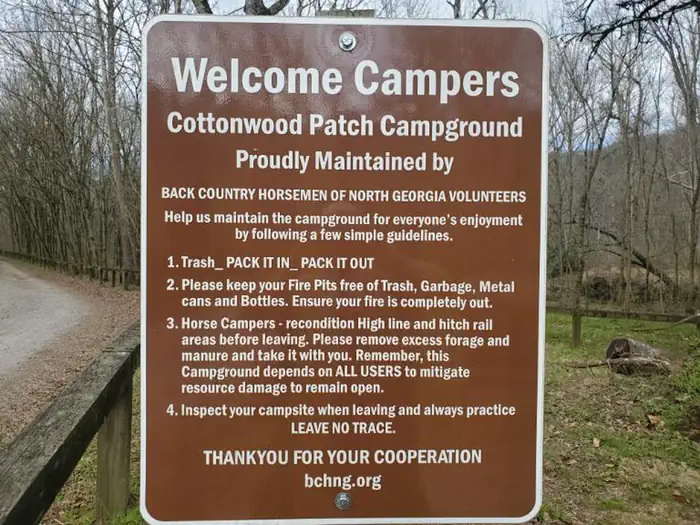
Overview Cottonwood Patch Campground is a multi-use campground focused primarily on equestrian camping, but welcomes traditional "car" camping. The campground is located within the Chattahoochee-Oconee National Forest in the Alaculsy Valley of the Cohutta Mountains in north Georgia.
Current weather
Loading current conditions…Pet suitability
Checking verified info…Weather guidance uses air temperature only; humidity or hot pavement may increase risk.
Online info—check with the campground or park before planning.
Uses verified pet access, leash rules, and air temperature.
Network availability
Coverage data not loaded for this area
This does not mean there is no signal. FCC carrier data for this area has not been loaded yet.
Amenities
About Cottonwood Patch Campground
Overview Cottonwood Patch Campground is a multi-use campground focused primarily on equestrian camping, but welcomes traditional "car" camping. The campground is located within the Chattahoochee-Oconee National Forest in the Alaculsy Valley of the Cohutta Mountains in north Georgia. Cottonwood Patch Campground is a quaint campground found along the Conasauga River, just above its junction with the Jacks River. Mixed hardwood forest surrounds the campground. The campground is partially shaded most of the summer with planted cottonwoods and sawtooth oaks. Average daytime summer temperatures are in the mid-80s with average daytime winter temperatures in the 50s. In the late 1800s into the 1930s, Alaculsy Valley was a thriving community. The valley contained homes, farms, a church, a post office, a grist mill, a school, cemeteries, and possibly a furnace for smelting iron. Across the Jacks River, in Tennessee, were other similar communities, a Civilian Conservation Corps work camp, and the location of the original U.S. Forest Service facility that managed the area. Some of the most development in the area was during the logging boom of the early 1900s. This area was the main hub for logging operations in the Cohutta Mountains. Train tracks followed the Conasauga and Jacks Rivers deep into the mountains. Lumbermen in logging camps far back in the mountains would cut timber and have it loaded onto flat cars. These loaded railroad cars would be pulled by the powerful Shay locomotives owned by the Conasauga River Lumber Company to its mill in Conasauga, Tennessee. Once an area was logged, the camp buildings would be loaded up onto the flat cars by small steam cranes and unloaded at the next area prepared for a camp. The Conasauga Trail in Tennessee follows the old railroad bed downstream and the Jacks River Trail in Georgia follows the old railroad bed upstream into the Cohutta Wilderness. Looking at the area today, one would never know such development once existed. The U.S. Forest Service, along with partnerships with other agencies and organizations, work together to manage the National Forest lands. Recreation activities around the Cottonwood Patch Campground include camping, picnicking, hiking, hunting, fishing, and horseback riding (visitors must provide their own horses). Hunting and fishing regulations are set by the Georgia Department of Natural Resources. Recreation The Cottonwood Patch Campground not only serves as a place to rest and relax by the campfire, but it serves as a base camp for activities located throughout the National Forest, such as hiking, horseback riding, hunting, fishing, and birdwatching. Cottonwood Patch Campground is a popular area for equestrian users. The start of the Iron Mountain trail is located in the campground. The trail can be used by both horse riders and hikers. Horses are permitted on numbered Forest Service Roads that are both open to traffic and gated. Please be aware and mindful of vehicular traffic on Forest Service Roads. Hunting is also a popular activity near the Cottonwood Patch Campground area. The 96,583 acre Cohutta Wildlife Management Area (WMA) is a cooperatively managed area within the boundaries of the Chattahoochee National Forest. The U.S. Forest Service and Georgia Department of Natural Resources work together to provide hunters opportunities to harvest bear, deer, wild hog, and various species of small game. The Georgia DNR maintains the majority of wildlife openings/food plots, conduct wildlife surveys, and set the hunting regulations. The U.S. Forest Service manages the receation facilities, roads, vegetation, fire, vegetation, and general forest. When hiking or riding horses during hunting seasons, wear blaze orange and be aware that hunters are out legally participating in their version of recreational activities. Amateur naturalists can have a great time seeking out non-game species, such as birds, small mammals, amphibians, and reptiles, along with hundreds of speci